Tag: Matt Mullenweg

  • Reflections on State of the Word 2025 and the Future of AI in WordPress

    Reflections on State of the Word 2025 and the Future of AI in WordPress

    There is a moment every year when the lights dim, the livestream timer counts down, and the room settles into that familiar mix of quiet and anticipation.  This year, State of the Word left me with a feeling I have not had in a long time.  It felt like all the threads of AI work happening across WordPress finally came together.

    If you have not watched the replay, it is worth it.

    Before I dig into the part I had the privilege of contributing to, here is a quick sense of how the event landed for me.

    The WordPress AI panel and the shift happening in real time

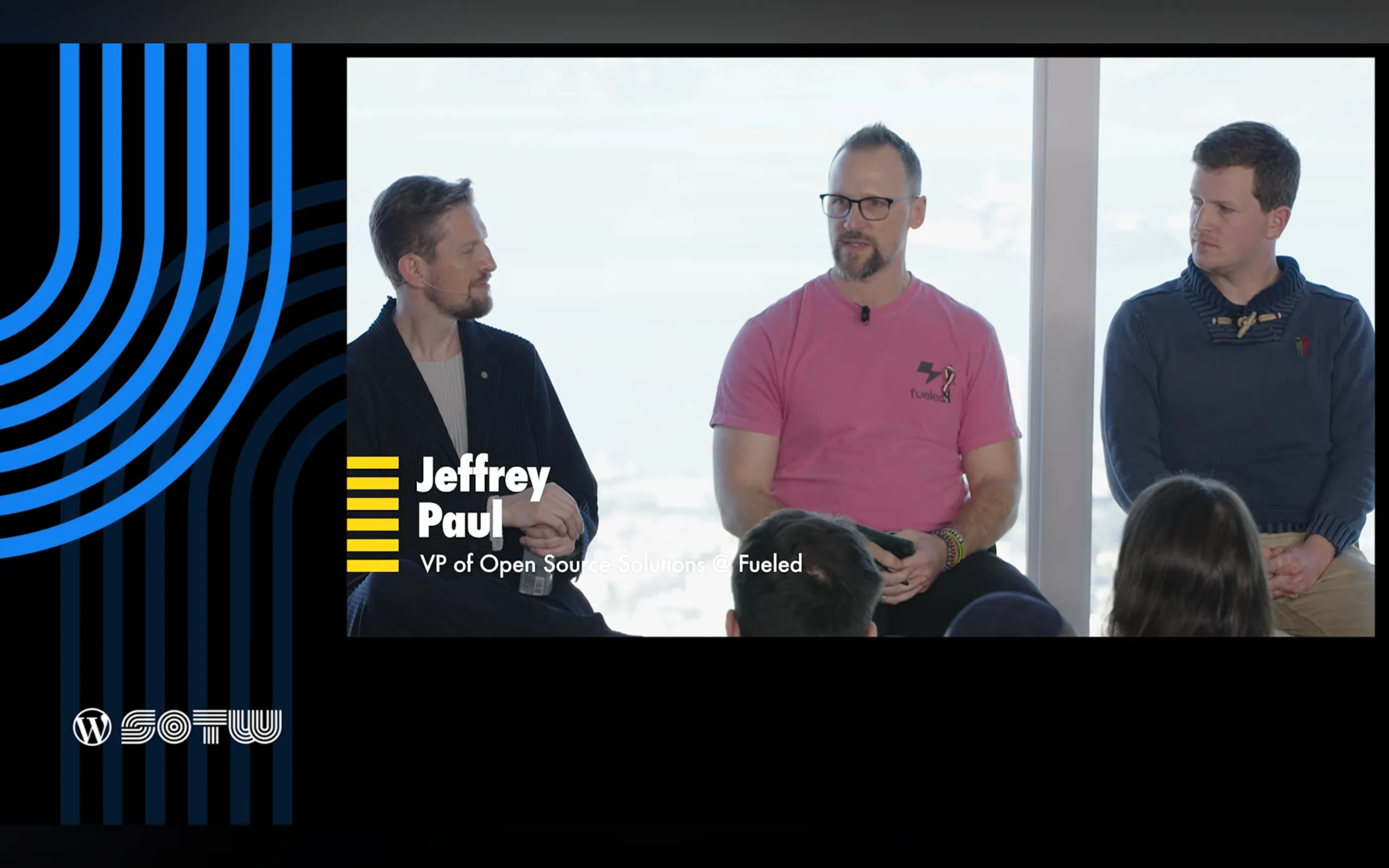
    One of the highlights of my year was joining the AI panel hosted by Mary Hubbard, alongside Matt Mullenweg, Felix Arntz, and James LePage.  Sitting on that panel, hearing how each of us approached AI from different angles, I realized we were not just discussing features.  We were describing a shift in how people will build and maintain sites in the coming years.

    This is where the “obvious and surprising things” came up.  These were ideas I shared during the panel, because they reflect what I have seen across Fueled (and 10up) client work, ClassifAI development, and now the AI Experiments plugin.

    The obvious things

    These are the patterns everyone expected to see, and they are becoming mainstream faster than many predicted.

    • Chat-based search showing up as a natural extension of site discovery
    • Local and in-browser models that run privately, offline, and at very low cost
    • AI-driven brand visibility (aka “GEO” or Generative Engine Optimization)
    • Content distribution and translation workflows that used to require entire engineering teams now becoming almost trivial

    These trends feel obvious only because the groundwork has been quietly laid for years.

    The surprising things

    The twist this year came from watching how people are starting to use the new Notes feature in WordPress 6.9.

    I mentioned this on the panel because it caught me off guard when I saw it bubbling up within the community during the 6.9 release cycle.  People are already experimenting with AI-driven content review inside Notes.  Imagine WordPress calling out accessibility issues, shifts in tone, or sections where your writing reads differently than you intended.  These are editorial tools that used to require specialized software.  Now they are emerging directly inside WordPress.

    That is when it hit me.  The AI conversation in WordPress is no longer about novelty.  It is about workflow, quality, and confidence.

    A journey that started long before this State of the Word

    For me, this work did not start with the AI Experiments plugin.  It started in 2018 when the 10up team built the first version of ClassifAI for a client who needed content classification at scale.  We open-sourced it in 2019 and kept evolving it as real publishers and agencies pushed its limits.

    Those years shaped everything I know about AI inside WordPress.  They taught me how AI fits into editorial workflows, when AI should require human review versus full automation, how permissions and provider selection affect trust, and how failure states must be designed with care.  Those lessons are now embedded in the AI Experiments plugin.

    ClassifAI will continue serving enterprise use cases with deep configurability.  It will adopt the Abilities API, MCP adapter, and WP AI Client as those stabilize in the ecosystem.

    The AI Experiments plugin takes a different path.  It offers simple, approachable example AI experiments for non-technical users, while also serving as a reference for developers, agencies, and hosts who want to build AI powered features for their customers.

    If you want a strong overview of how we are building the AI Experiments plugin, my colleague Darin Kotter wrote a great breakdown: Making AI Experiments: The Official Reference Plugin for WordPress AI.

    What is in the AI Experiments plugin today and what is coming next?

    A purple and pink background

    Version 0.1.0

    This first release set the foundation with:

    • Title Generation
    • Credentials and Settings screens
    • An experiment registry
    • An example experiment for developers

    It created the structure we needed to introduce more complex features.

    Version 0.2.0

    The next release is where the plugin starts to feel alive. It is targeting:

    • Excerpt Generation
    • Image Generation
    • Alt Text Generation
    • Abilities Explorer
    • A live MCP demonstration
    • An AI Playground inspired by Felix’s work in the AI Services plugin

    Each of these experiments helps us learn how people want to use AI inside their workflows, and which features could grow into stable tools inside core one day.

    Looking ahead

    This year’s State of the Word left me excited about something simple.

    We are not racing toward AI.

    We are shaping AI so it fits naturally into the way people already work in WordPress.

    We are building an ecosystem where:

    • open tools remain the default (I’m specifically passionate about open source, local LLMs)
    • user choice stays central
    • and AI enhances creativity instead of replacing it

    If you want to explore the AI Experiments plugin or get involved, you can follow everything in the open: https://github.com/WordPress/ai.  And if you have ideas or want to push the boundaries of what is possible, I would love to hear them.
    Fediverse Reactions
  • In response to Matt Mullenweg’s “WordCamp Canada Talk”

    In response to Matt Mullenweg’s “WordCamp Canada Talk”

    I had the privilege of speaking twice at WordCamp Canada (“WCEH”; as in WordCamp, eh?)this year but had to leave before Matt Mullenweg’s town hall because of a family emergency.  After catching up later through his recap post, I was struck by how much ground he covered, from personal publishing tools and encrypted journaling to AI, open media, and the future of the web itself.

    His remarks touched on several themes that feel central to WordPress’s next chapter: helping people reclaim their online identities beyond centralized platforms, and navigating the tension between openness and authenticity as AI reshapes how we create and trust content.

    I wanted to ask Matt two questions that build on those ideas about the role WordPress can play in making “publish once, syndicate everywhere” a reality, and how it might help rebuild trust in what’s real online.

    Let me give a little update on what I’ve been up to. My life’s mission is to democratize publishing, commerce, and messaging.

    On the social side of publishing, I have Tumblr, which is a microblogging social network, but right now it’s on a different technical stack. I need to switch it over to WordPress, but it’s a big lift. It’s over 500 million blogs, actually, and as a business, it’s costing so much more to run than it generates in revenue. We’ve had to prioritize other projects to make it sustainable. It’s probably my biggest failure or missed opportunity right now, but we’re still working on it.

    Day One is a fully encrypted, shared, and synchronized blogging and journaling app that runs on every device and on the web. You can also have shared encrypted journals with others. It uses the same encryption as one password. It’s the first place I go to draft an idea—for example, to write this talk. Its editor is not as good as Gutenberg yet, but it’s pretty decent at allowing multimodal input—which means you can record voice notes, draw things, etc.—and capturing it all. It’s mostly replaced Evernote, Simplenote, and even private P2s for me. It has some fun features, like when you make a new entry it records, the location, what music you’re listening to on Apple Music, how many steps you’ve taken, the weather. Honestly, some features that would be nice to get into WordPress, at least as a plugin.

    So WordPress.com Studio is built on an open source project called Playground that we created to allow you to spin up WordPress in a WASM container in about 30 seconds, right inside your browser.

    So my first question to Matt is this: WordPress powers much of the open web, but most people still publish primarily on centralized social platforms.  There were some good talks at WCEH on the open web, the social web, and the indie web, shared by Dave Winer and Evan Prodromou this week and by Tantek Çelik at WCUS 2019What role do you see WordPress, either in core or through plugins, playing to help people reclaim their online identity and make ‘publish once, syndicate everywhere’ a mainstream reality?

    However, when AI creates a face, there’s no such restrictions there. So something that we could actually start to do, because right now I think we have some anti-AI rules in the photo directory, I think we should probably start to look at evolving that. So, for example, you can take a picture of me right now, change my face with AI to a face that has never existed, and that could be CC0-licensed and anyone in the world could use it. So I think there’s some possibilities there.

    I also think there’s some opportunities to use AI analysis of all the photos to give a better semantic understanding and a better search that we currently offer, which right now is typically monollingual, I don’t think it translates well into the, you know, 60-plus languages that WordPress supports, and it’s manual tagging. So there might be things to do, like a more automated understanding, which, of course, gets better over time.

    You know, we started to incorporate some of the AI models like Gemini and other things on WordPress.org to make us way more efficient on things like plug-in submissions and some code scanning. I actually think we’re very much in chapter one of where this is going to be.

    So first I will say, I don’t want to say that there’s bad actors. I think there might be bad actions sometimes, and just temporarily bad actors who hopefully will be good in the future. You know, every saint has a past, every sinner has a future. I never want to define any company or any person as permanently good or bad. Let’s talk about actions.

    Which leads to my second question for Matt: As AI makes it harder to tell what’s real online, trust in content is slipping.  The Breaking News episode of RadioLab in 2019 showed how deepfakes blur the line between truth and fiction.  How can WordPress and the open web help rebuild that trust?  For example, could it support initiatives like the Content Authenticity Initiative that use open tools to verify the source and history of digital media?

    Featured image source: https://canada.wordcamp.org/2025/thats-a-wrap-for-wordcamp-canada-2025-wceh2025/

    Fediverse Reactions